

I started making oolong peach iced tea the week I found a real clinical trial on oolong and fat oxidation, mostly out of skepticism. Most “metabolism-boosting” drink claims online trace back to nothing at all. This one traces back to an actual randomized trial, with real limits I’ll walk through below, and the tea itself turned out good enough to keep making regardless of what the research says.
Why This Oolong Peach Iced Tea Works
Oolong sits between green and black tea in processing. The leaves are only partially oxidized, usually somewhere between 10% and 80% depending on the style, which is why a good oolong can taste floral like green tea or toasty like black tea. That partial oxidation is also where the compounds researchers link to fat metabolism come from. They don’t survive black tea’s full oxidation, and green tea never develops them at all.
Steeping at 195°F instead of a full boil keeps those compounds intact instead of scorching them into bitterness. Peach works well here because its low acidity doesn’t fight the tea’s natural sweetness the way citrus can flatten a delicate oolong.
Key Ingredient Notes
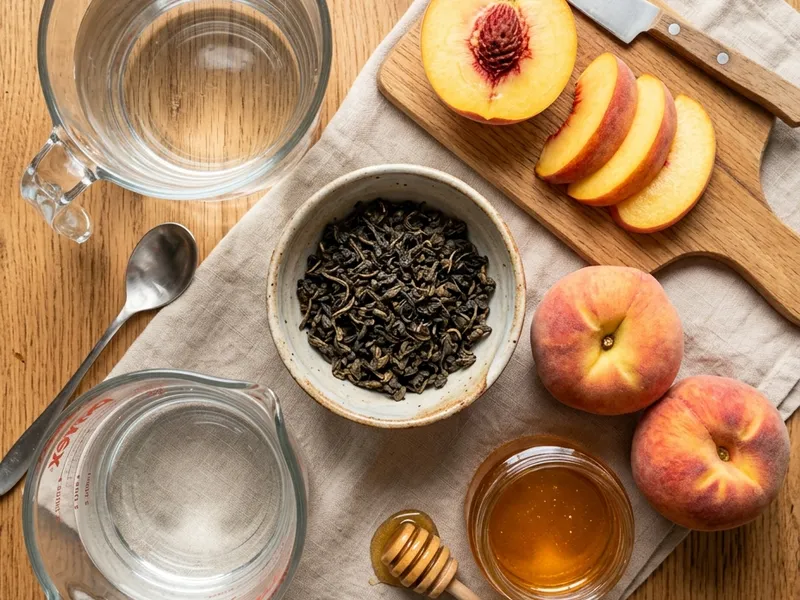
Loose-leaf oolong makes a real difference in this oolong peach iced tea recipe. Bagged oolong is almost always lower grade, chopped fine enough that it over-extracts and turns bitter fast. I buy mine from a local tea shop that sells by the ounce, which means I can smell it before committing to a bag.
Fresh peaches for this oolong peach iced tea work when they’re actually in season and give slightly under a gentle squeeze. Out of season, frozen peach chunks blend into a better syrup than the mealy fresh ones from a grocery store in February. Freezing breaks down the cell walls, the same way it does in a smoothie, releasing more flavor once thawed.
What I Learned Testing This
I over-steeped my first batch by nine minutes instead of four, standing in my kitchen on a July afternoon trying to answer emails at the same time. The tea came out sharp and puckering, closer to chewing on a tea bag than drinking it. Four minutes at 195°F, pulled the moment the timer goes off, is the number that’s stuck since then.
What the Metabolism Research on Oolong Actually Shows
Here’s the study behind the claim, not the vague version marketing pages repeat. A 2020 randomized, placebo-controlled, double-blinded crossover trial from the University of Tsukuba, published in Nutrients, gave 12 non-obese men caffeine and oolong tea over a 14-day period and measured a roughly 20% increase in fat oxidation compared to placebo, with no change in total energy expenditure or sleep quality.
The researchers found no significant change in body weight, BMI, or body fat percentage over those 14 days, and said so directly: two weeks wasn’t long enough to know whether that fat-oxidation bump “actually reduces body fat,” calling it something that “remains to be evaluated.” That’s the honest read on this oolong peach iced tea’s research backing — a real, measured metabolic effect, not a proven weight-loss mechanism.
The study also only looked at 12 non-obese men, so it says nothing yet about whether women or people carrying more body fat would see the same result. Oolong runs roughly 30-50mg of caffeine per cup — worth checking against the Mayo Clinic’s 400mg/day guidance if you’re sensitive to it.
Tips and Variations
A few ways to change up this oolong peach iced tea once the base method is dialed in:
- Swap peach for nectarine when peaches are out of season, for a similar texture and slightly less sweetness.
- Add a few mint leaves to the pitcher for the last 10 minutes of chilling only, or it turns grassy.
- Cold-brew this oolong peach iced tea overnight in the fridge instead of hot-steeping for a smoother, less astringent base.
- Skip the sweetener entirely and let the peach syrup carry all the sweetness on its own.

Troubleshooting This Oolong Peach Iced Tea
Tastes bitter or astringent: You over-steeped it, or the water was too hot. Pull the leaves at four minutes and keep the water at 195°F, not a rolling boil.
Peach flavor is weak: Fresh peaches out of season are usually the problem. Use frozen peach chunks for the syrup instead, since they blend into something stronger than a bland winter peach.
Tea turns cloudy over ice: That’s tannins reacting to rapid cooling. Let the tea cool to room temperature before pouring over ice instead of icing it straight from hot.
Tastes watered-down by the time you finish the glass: Melting ice dilutes any iced tea fast. Brew this one slightly stronger than you’d drink it hot, or freeze extra tea into ice cubes so the glass doesn’t dilute itself as it melts.
More Recipes You’ll Love
If oolong is becoming a habit, my oolong milk tea recipe uses the same 195°F steeping principle in a creamier direction, and the full oolong tea drinks roundup covers six more ways to use the same base tea. Both, plus this one, live on the tea drinks hub if you want to browse the full lineup.
The short version of this oolong peach iced tea recipe: steep loose-leaf oolong at 195°F for four minutes, mix with a fresh or frozen peach syrup, and pour over ice once fully cooled. A 2020 clinical trial found a real, modest fat-oxidation bump from oolong and caffeine together, but the researchers themselves say it’s not yet proof of actual weight loss.

Oolong Peach Iced Tea
Equipment
- 1 Teapot or heatproof pitcher
- 1 Fine mesh strainer
- 1 Blender for the peach syrup
Ingredients
For the Tea
- 4 tsp loose-leaf oolong tea
- 4 cups water heated to 195F, not boiling
For the Peach Syrup
- 2 cups fresh or frozen peach chunks
- 1/4 cup sugar or honey adjust to taste
- 1/4 cup water
To Serve
- 1 as needed ice cubes
- 1 as needed fresh peach slices for garnish
Instructions
Brew the Oolong
- Heat the water just until small bubbles form on the bottom of the pot, well below a rolling boil. A thermometer helps here since oolong scorches easily at full boil.
- Add the loose-leaf oolong and steep for exactly 4 minutes. Pull the leaves the moment the timer goes off to avoid bitterness.
- Strain out the leaves and let the tea cool to room temperature before refrigerating.
Make the Peach Syrup
- Combine the peach chunks, sugar or honey, and water in a small saucepan. Simmer over medium heat for 5-7 minutes, mashing the fruit as it softens.
- Blend the softened peach mixture until smooth, then strain through a fine mesh strainer into a jar to remove the pulp and skins.
Assemble the Tea
- Stir the cooled peach syrup into the chilled oolong tea, tasting and adjusting sweetness as you go.
- Fill glasses with ice, pour the tea over the top, and garnish with a fresh peach slice.
Notes
Frequently Asked Questions
Does oolong tea actually boost metabolism?
A 2020 randomized trial found oolong tea plus caffeine increased fat oxidation by about 20% over 24 hours in 12 non-obese men, with no change in energy expenditure. Researchers said it’s too early to call it proven weight loss support.
How long should I steep oolong for iced tea?
Steep loose-leaf oolong for about 4 minutes at 195F, just below boiling. Longer steeping or hotter water pulls out tannins and makes the tea bitter.
Can I use fresh peaches instead of frozen?
Yes, if they’re in season and give slightly under a gentle squeeze. Out of season, frozen peach chunks usually blend into a stronger, less mealy syrup than off-season fresh fruit.
How much caffeine is in oolong peach iced tea?
Oolong runs roughly 30-50mg of caffeine per cup, less than black tea and well under the FDA’s 400mg daily guidance for most healthy adults.
Can I make this oolong peach iced tea ahead of time?
Yes. Brew the tea and peach syrup separately and refrigerate for up to 3 days, combining just before serving so the tea doesn’t dilute as it sits over ice.
Why does my oolong iced tea turn cloudy?
Cloudiness comes from tannins reacting to rapid temperature change. Let the tea cool to room temperature before pouring it over ice instead of icing it while still hot.